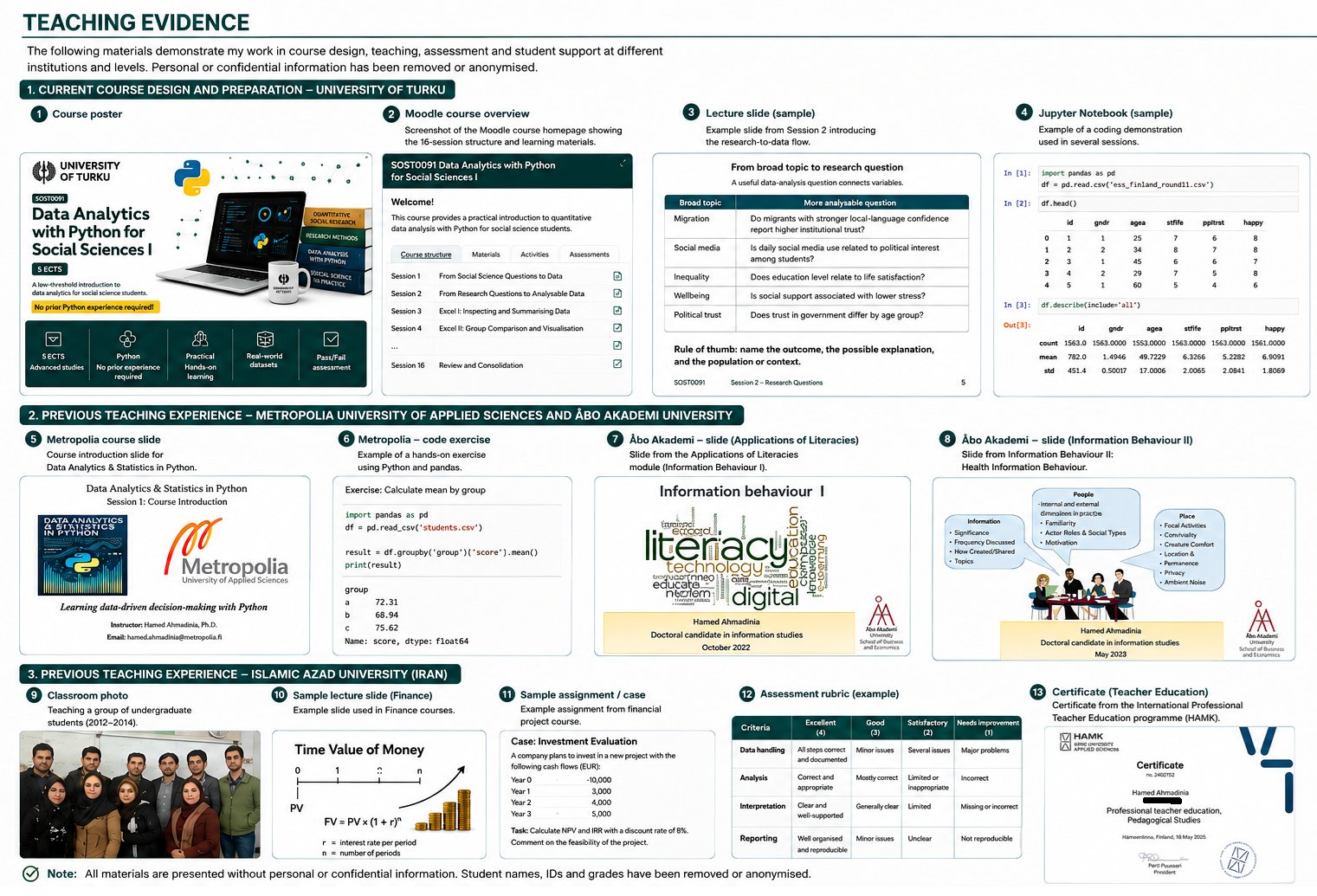
Course development and documented teaching across the University of Turku, Metropolia University of Applied Sciences, Åbo Akademi University and Islamic Azad University.
Teaching Portfolio
A. Course development and teaching at the University of Turku
I have designed and will teach SOST0091 Data Analytics with Python for Social Sciences I, a five-credit advanced-studies course at the University of Turku. The course runs from 3 November to 18 December 2026 and is taught in English.
The course provides a low-threshold introduction to quantitative data analysis for social science students. No previous Python experience is required. Students are expected to have completed bachelor-level quantitative methods or equivalent studies.
The course begins with social science research questions, concepts and measurement. Students then progress through Excel, Python, data cleaning, missing-data management, descriptive statistics, visualisation, probability, hypothesis testing, reproducible analysis and an introduction to statistical learning.
The course uses authentic social science and public datasets, including the European Social Survey, General Social Survey, World Development Indicators, Gapminder, World Happiness Report, Freedom House data, Statistics Finland data and other teaching datasets.
My responsibilities include designing the course and its Moodle environment, preparing and delivering lectures and computer laboratories, creating slides and Jupyter Notebooks, selecting and preparing datasets, producing instructional videos, developing H5P activities and Kahoot quizzes, preparing assignments, giving feedback and supervising the data-analysis report and final mini-project.
The published course workload consists of 24 lecture hours, 16 computer-laboratory hours and approximately 95 hours of independent study. Assessment is based on weekly hands-on exercises, a data-analysis report and a final mini-project. The course is assessed as Pass/Fail.
Table 1. Teaching details at the University of Turku
| Date | Session topic | Learning goals | Responsibilities | Hours |
|---|---|---|---|---|
| 03.11.2026 | Session 1: From Social Science Questions to Data | Recognise different types of social science data and connect research questions with variables and evidence. | Lecture delivery, guided discussion, paper-based dataset activity, Kahoot review and Moodle exercise. | 2 lecture hours |
| 05.11.2026 | Session 2: From Research Questions to Analysable Data | Turn broad topics into answerable research questions, measurable variables and basic codebooks. | Lecture delivery, research-question exercises, operationalisation activities and codebook guidance. | 2 lecture hours |
| 10.11.2026 | Session 3: Inspecting and Summarising Social Science Data — Excel I | Inspect datasets and calculate counts, percentages, measures of centre and measures of spread in Excel. | Excel demonstrations, guided formula practice, interpretation activities and exercise support. | 2 lecture hours |
| 12.11.2026 | Session 4: Excel II — Group Comparison, Visualisation, Lookup and Regression Preview | Compare groups, create PivotTables and charts, use lookup functions and interpret introductory regression output. | Excel demonstrations, group-comparison exercises, visualisation guidance and regression discussion. | 2 lecture hours |
| 13.11.2026 | Session 5: Computer Lab I — Opening, Inspecting and Cleaning ESS Survey Data | Open data files, inspect variables and codes, clean missing values, recode variables and save analysis-ready data. | Computer-laboratory supervision, pandas demonstrations, troubleshooting and notebook feedback. | 3 laboratory hours |
| 17.11.2026 | Session 6: Python I — Cleaning and Reshaping WDI Macro Data | Remove non-data rows, rename columns, reshape data from wide to long format and produce summaries. | Python demonstrations, coding exercises, data-preparation guidance and notebook support. | 2 lecture hours |
| 19.11.2026 | Session 7: Python II — Missing Data and Analysis-Ready GSS Records | Detect labelled missing values, replace them correctly, convert variables and document cleaning decisions. | Teaching missing-data principles, coding demonstrations, exercises and feedback. | 2 lecture hours |
| 20.11.2026 | Session 8: Computer Lab II — Reproducibility, Debugging and Gapminder | Structure a readable notebook, check data quality, debug errors, save outputs and run a complete analysis reproducibly. | Laboratory supervision, debugging support, reproducibility checks and notebook review. | 3 laboratory hours |
| 24.11.2026 | Session 9: Descriptive Statistics and Exploratory Data Analysis | Calculate and interpret centre, spread, frequencies, percentages, group comparisons, cross-tabulations and correlations. | Statistical explanation, Python demonstrations, interpretation exercises and coding support. | 2 lecture hours |
| 26.11.2026 | Session 10: Python Visualisation — Honest, Accessible Social Science Charts | Create appropriate distribution, group-comparison and relationship charts and apply accessible design principles. | Visualisation teaching, chart demonstrations, design review and feedback on student-created figures. | 2 lecture hours |
| 27.11.2026 | Session 11: Computer Lab III — A Mini Visual EDA Report | Connect a focused research question with data cleaning, a descriptive table, visualisations and limitations. | Laboratory supervision, report development, chart review and written-interpretation feedback. | 3 laboratory hours |
| 01.12.2026 | Session 12: Probability and Variability | Understand observed probabilities, expected values, variance, standard deviation, z-scores, sampling variability and intervals. | Explanation of probability concepts, Python simulations, guided exercises and interpretation support. | 2 lecture hours |
| 03.12.2026 | Session 13: Hypothesis Testing with Descriptives First | Conduct and interpret Welch’s t-test, chi-square tests and ANOVA, calculate effect sizes and check assumptions. | Statistical teaching, test demonstrations, diagnostic guidance and reporting exercises. | 2 lecture hours |
| 04.12.2026 | Session 14: Full Analysis Pipeline — From Raw Table to Mini-Project Draft | Complete an analysis from a research question and raw data to cleaning, tables, visualisations, comparisons and limitations. | Full-day laboratory teaching, individual troubleshooting, analysis guidance and mini-project support. | 7 laboratory hours |
| 08.12.2026 | Session 15: Statistical-Learning Bridge | Distinguish targets from predictors, understand training and test data and interpret a simple predictive model cautiously. | Guided model demonstration, evaluation exercises and discussion of limitations. | 2 lecture hours |
| 10.12.2026 | Session 16: Review and Consolidation — Repair the Workflow | Diagnose and repair inconsistent variable names, mixed types, missing values and duplicates. | Course review, debugging workshop, individual feedback and mini-project preparation. | 2 lecture hours |
Final assessment session
| Date | Activity | Purpose | Responsibilities | Hours |
|---|---|---|---|---|
| 18.12.2026 | Final mini-project and course assessment | Demonstrate a correct, reproducible and clearly reported social science data analysis. | Final guidance, assessment, feedback and course completion. | 4 hours |
B. Teaching experience at Metropolia University of Applied Sciences
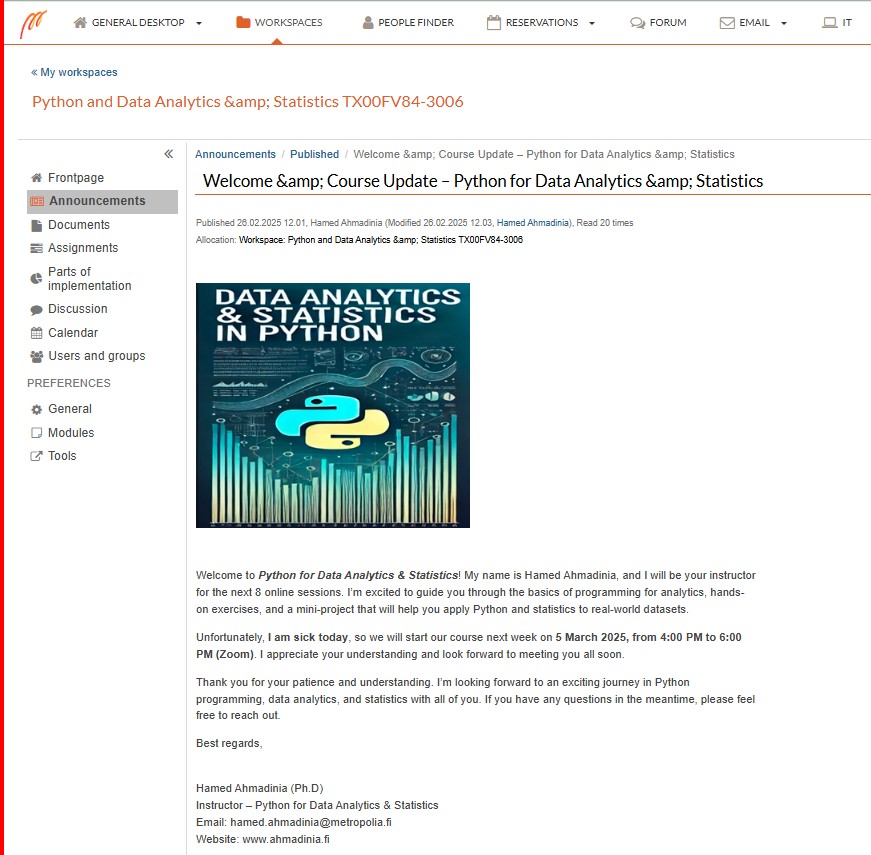
As part of my pedagogical training in the International Professional Teacher Education programme at Häme University of Applied Sciences, I taught Data Analytics & Statistics in Python at Metropolia University of Applied Sciences.
The three-credit course was offered through the Information Technology programme for Bachelor’s and Master’s students in Engineering. It developed practical skills in data analytics, statistical modelling and data visualisation using Python.
The curriculum covered data manipulation with pandas and NumPy, descriptive and inferential statistics, probability distributions, regression, correlation, time-series forecasting and predictive analytics. A specialised section introduced cryptocurrency data analytics to connect statistical methods with a practical application.
My responsibilities included designing and delivering online lectures, creating coding exercises and assignments, assessing student progress and supervising final mini-projects. The course followed an interactive, project-based approach in which students applied methods to real datasets.
Table 2. Teaching details at Metropolia University of Applied Sciences
| Date | Session topic | Learning goals | Responsibilities | Hours |
|---|---|---|---|---|
| 05.03.2025 | Python recap | Review basic Python concepts and syntax. | Lecture delivery, hands-on coding exercises and guided discussion. | 2 teaching hours + 15 planning and supervision hours |
| 12.03.2025 | Matrices and data frames | Manipulate data using NumPy and pandas. | Lecture delivery, coding exercises and troubleshooting. | 2 teaching hours + 15 planning and supervision hours |
| 19.03.2025 | Statistics: theory and application | Understand key statistical measures. | Explanation of statistical concepts and facilitation of practical exercises. | 2 teaching hours + 15 planning and supervision hours |
| 26.03.2025 | Probability and variability | Understand probability distributions and significance tests. | Teaching probability concepts and guiding probability-based coding exercises. | 2 teaching hours + 15 planning and supervision hours |
| 02.04.2025 | Relationships between variables | Explore regression and correlation. | Explanation of regression models and guidance in correlation analysis. | 2 teaching hours + 15 planning and supervision hours |
| 09.04.2025 | Data visualisation | Create effective visualisations with Matplotlib and seaborn. | Teaching visualisation techniques and reviewing student-created charts. | 2 teaching hours + 15 planning and supervision hours |
| 16.04.2025 | Advanced topics and integration | Apply several analytical methods to practical problems. | Explaining integrated analytical workflows and guiding exploratory analysis. | 2 teaching hours + 15 planning and supervision hours |
| 23.04.2025 | Student mini-project presentations | Present and discuss projects that demonstrate learning. | Providing feedback, evaluating final projects and grading presentations. | 2 teaching hours + 15 planning and supervision hours |
C. Teaching experience at Åbo Akademi University
During my doctoral studies in the Faculty of Social Sciences, Business and Economics, and Law at Åbo Akademi University, I contributed to teaching in information studies.
I created and delivered modules for the international Master’s programme in Governance of Digitalisation, particularly within Information Behaviour I and Information Behaviour II.
In autumn 2022, I taught the Applications of Literacies module in Information Behaviour I. The module focused on information literacy, digital literacy and the role of digital skills in personal, academic and professional life.
During the spring terms of 2022, 2023 and 2024, I taught a section of Information Behaviour II on health information behaviour. The teaching covered health-information-seeking behaviour, personal and contextual influences on information practices and the Health Belief Model. These sessions were informed by my doctoral research.
Table 3. Teaching details at Åbo Akademi University
| Academic year | Course | Module taught | Responsibilities | Hours |
|---|---|---|---|---|
| Spring 2024 | Information Behaviour II | Health Information Behaviour | Preparing and recording lectures, facilitating group assignments and learning diaries, and grading activities. | 1 teaching hour + 15 supervision hours |
| Spring 2023 | Information Behaviour II | Health Information Behaviour | Preparing and recording lectures, facilitating group assignments and learning diaries, and grading activities. | 1 teaching hour + 15 supervision hours |
| Autumn 2022 | Information Behaviour I | Applications of Literacies | Preparing and recording lectures, facilitating group assignments and learning diaries, and grading activities. | 1 teaching hour + 15 supervision hours |
| Spring 2022 | Information Behaviour II | Health Information Behaviour | Preparing and recording lectures, facilitating group assignments and learning diaries, and grading activities. | 1 teaching hour + 15 supervision hours |
D. Teaching experience at Islamic Azad University
From 2011 to 2014, I worked as a lecturer and researcher at Islamic Azad University before moving to Finland to complete my second Master’s degree and doctorate.
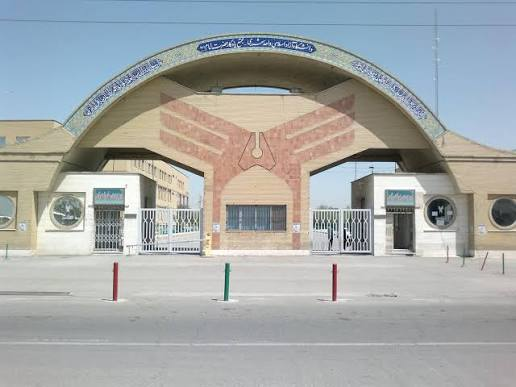
I taught students at associate-degree and Bachelor’s levels in finance, taxation, accounting, investment, financial projects and computer applications in accounting.
My teaching combined clear explanations, practical examples, structured exercises, group assignments, case analysis, written examinations and applied projects. I used everyday financial decisions and business situations to help students understand abstract concepts.
Table 4. Teaching details at Islamic Azad University
| Course | Semester / year | Code | Level | Type | Credits | Hours per semester |
|---|---|---|---|---|---|---|
| Investing in the Stock Exchange | Summer 2012–2013 | 718 | Bachelor’s | Core | 2 | 32 |
| Finance 2 | Summer 2012–2013 | 1309 | Bachelor’s | Core | 3 | 48 |
| Tax Accounting | Second semester 2012–2013 | 4092 | Associate degree | Core/elective | 2 | 32 |
| Tax Accounting | Second semester 2012–2013 | 4091 | Associate degree | Core/elective | 2 | 32 |
| Tax Accounting | Second semester 2012–2013 | 4094 | Associate degree | Core/elective | 2 | 32 |
| Finance Class | Second semester 2010–2011 | 7356 | Bachelor’s | Core | 3 | 48 |
| Tax Accounting | Second semester 2010–2011 | 10307 | Bachelor’s | Core | 2 | 32 |
| Tax Accounting | Second semester 2010–2011 | 7085 | Bachelor’s | Core | 2 | 32 |
| Tax Accounting | First semester 2013–2014 | 1603 | Associate degree | Core/elective | 2 | 32 |
| Tax Accounting | First semester 2013–2014 | 1604 | Bachelor’s | Core | 2 | 32 |
| Tax Accounting | First semester 2013–2014 | 3827 | Associate degree | Core/elective | 2 | 32 |
| Tax Accounting | First semester 2013–2014 | 3829 | Associate degree | Core/elective | 2 | 32 |
| Tax Accounting | First semester 2013–2014 | 3832 | Associate degree | Core/elective | 2 | 32 |
| Finance 1 | First semester 2011–2012 | 4883 | Bachelor’s | Core | 3 | 48 |
| Tax Accounting | First semester 2011–2012 | 11502 | Bachelor’s | Core | 2 | 32 |
| Tax Accounting | First semester 2011–2012 | 11505 | Bachelor’s | Core | 2 | 32 |
| Computer Application in Accounting – 2 | First semester 2011–2012 | 11511 | Bachelor’s | Core/elective | 2 | 32 |
| Tax Accounting | First semester 2011–2012 | 3793 | Associate degree | Core/elective | 2 | 32 |
| Tax Accounting | First semester 2011–2012 | 3788 | Bachelor’s | Core | 2 | 32 |
Loading comments…